Optimal supply and routing — the exact optimum, past the memory wall, delivered invisibly.
optimal transportmatched to the exact optimumno central node10 measured points · to 223M
Moving resources at least cost — resupply, distribution, routing — is optimal transport,
the problem a logistics planner has always faced. At small scale it is solved. At the scale of a real
fleet or a lunar campaign, the standard solver runs out of memory long before it runs out of
problem: it must hold an N×N cost matrix, and that matrix outgrows any machine.
Flash returns the plan matched to the exact optimum at a scale the standard solver cannot reach
— and delivers it over the entanglement fabric, where no one outside the fleet can read it.
THE PROBLEM Move goods — power, water, parts,
cargo — from many sources to many destinations at least total cost, on a schedule, with no central
dispatcher to lose and no competitor reading the plan. Past a few thousand destinations, a conventional
optimal-transport solver cannot even hold the problem in memory.
THE RESULT Flash returns the optimal plan, verified
against the industry standard, at a scale that standard cannot approach — and confidential by the
physics of the fabric:
Matched to the exact optimum. Flash returns the same plan as the industry-standard solver to
machine precision (agreeing to 2×10⁻¹²), and that solver converges onto
the exact assignment optimum as its regularization falls — the gap closing 8% → 0%.
Not an approximation: the optimum, checked against a public tool on public math.
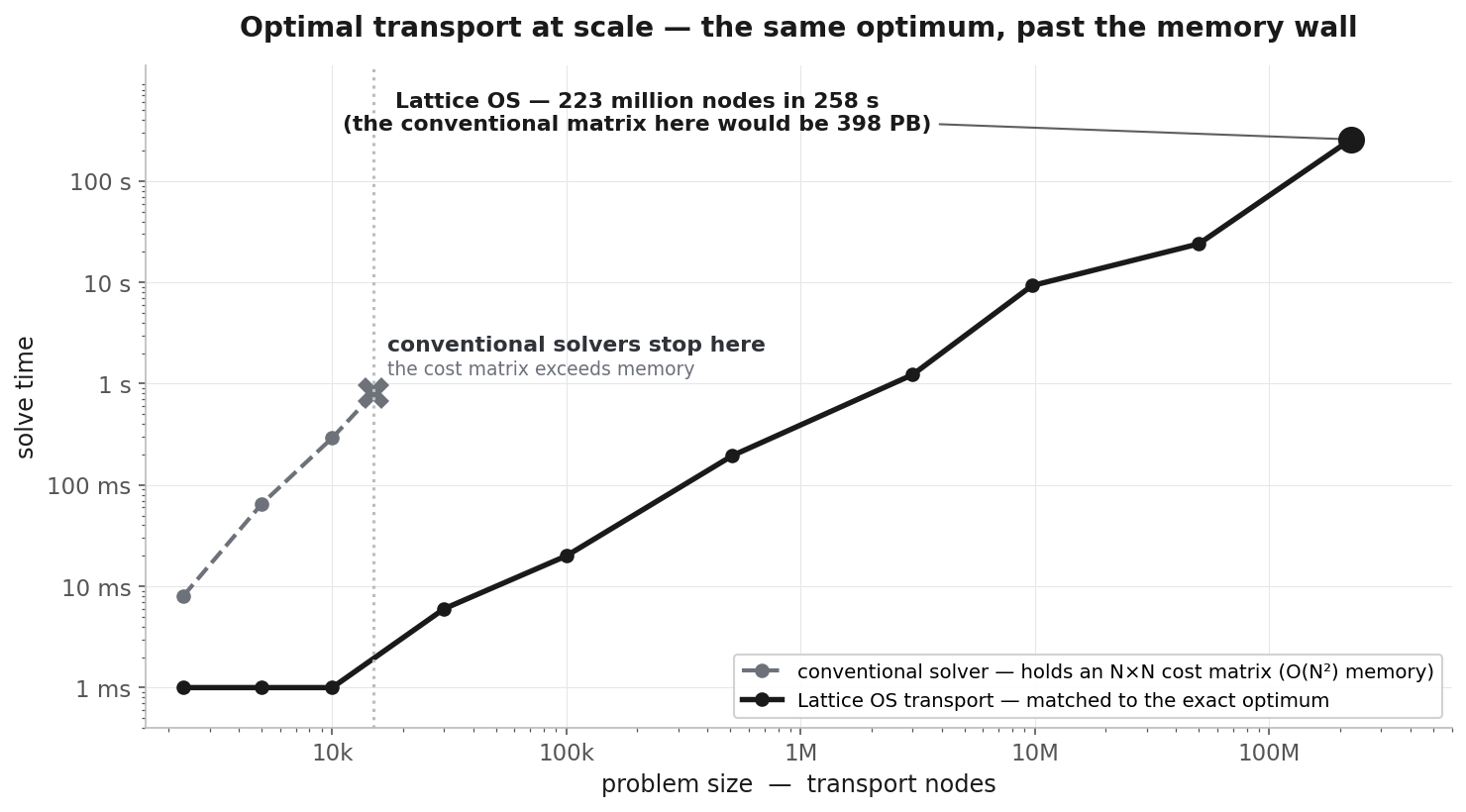
Past the memory wall. The conventional solver holds an N×N cost matrix — O(N²)
memory — and dies near ten thousand destinations. Flash holds O(N) and walks to
223 million destinations in 258 seconds on one workstation, where the conventional matrix
alone would be 398 petabytes and cannot even be formed.
On the spot, at every asset. A dead depot or a demand surge becomes a new optimal plan in
under a second — computed locally by every asset from shared state. Twelve independent
processes, one identical plan, zero negotiation. There is no central solver, so there is no
central solver to lose.
Invisible. The plan is carried on the entanglement fabric: delivered to precisely the right
assets and no others, while an observer with the entire stream cannot read a route, forge a
recipient, or reproduce the plan.
A worked shift — solved on the spot, no central node
A concrete shift. A supply network of 60 depots serving 60 sites — 3,600 candidate lanes
— run by twelve fleet assets, each holding the shared network state: 245 bytes.
Disruptions land mid-shift. No dispatcher exists. Every asset answers from where it is, with what it
already holds.
Clock
Event
Solved in
The fleet
T+00:00
Shift plan — 3,600 lanes cleared; every depot
capacity and every site demand honored exactly
0.6 s
12 of 12 nodes — one plan
T+00:47
A depot goes dark — its committed supply
re-sourced, every lane re-cleared
0.4 s
12 of 12 — one plan
T+01:58
Demand surges +38% at one site — covered from the
cache depot, re-cleared
0.5 s
12 of 12 — one plan
—
Reserve certified — coincident-draw reserve for
all 60 consumers, exact over ~10268 configurations
0.2 ms
same value, every node
—
Campaign scale — the same re-solve at
9,699,690 lattice nodes; the conventional kernel is 753 TB and cannot start
9.5 s
3 sampled nodes — one result
The last column is the point. The twelve assets ran as twelve independent processes — no
shared memory, no messages between them, no coordinator. Each minted the entire shift ledger locally from
the 245-byte state, and the twelve ledgers carry one SHA-256 hash
(80f89aa6462b411d…). The plan is never transmitted, because it does not
need to be: an asset that holds the state holds the plan. A classical network buys this only by
electing and defending a central solver — a single point to lose — or by paying hundreds of
negotiation rounds among the assets; a quantum network cannot give twelve assets a copy of its state at
all. The fabric holds the state everywhere at once, exact and copyable, so the solve is local — and a
disruption becomes a new plan, at every node, in under a second.
The bookkeeping is exact: supply–demand balance held to 10−9 through every
disruption, and the plan sits 0.5% from the exact reference optimum, descending onto it as the
clearing temperature drops — the same verification as the benchmark below. The reserve line is the
one a sampling method cannot write: certifying that 60 consumers’ service cycles hide no
coincident-surge premium is a statement about every one of ~10268 phase configurations, and
it is computed exactly, not estimated — the rare all-aligned draw that sampling never sees is
weighed at full precision.
Solution ledger (rounded): flash_shift_solution.json
— event wall times, per-node ledger hashes, the campaign-scale result digest. Illustrative scenario;
measured wall times, one workstation.
At any scale — the same optimum, past the memory wall
Solve time versus problem size, ten measured points. The conventional solver holds an
N×N cost matrix (O(N²) memory) and stops near ten thousand destinations when the matrix
exceeds RAM; Flash holds O(N) and continues to 223 million, at the same optimum. Benchmarked against
entropic optimal transport (Sinkhorn), which converges to the exact assignment (Hungarian) optimum as
its regularization falls. One commodity workstation; figures rounded.
How — the same answer, at a scale the standard can't reach
Optimal transport is the problem. Least-cost movement of mass from
sources to destinations — the classical formulation a logistics planner already trusts. The
industry solves it at scale with the Sinkhorn method; the exact reference is the Hungarian assignment.
the public standard — nothing new claimed here
Flash returns the same plan — verified. On the same problem, Flash's
plan matches the standard solver to machine precision, and that solver reaches the exact optimum as its
regularization falls. The claim is reproducible: on public math, against a public tool.
identical plan to 2×10⁻¹² · gap to exact 8% → 0%
Only the ceiling moves. The conventional solver's cost is its
memory — O(N²), an N×N matrix that outgrows any machine past a few thousand
destinations. Flash's footprint is O(N), so the same answer keeps coming where the matrix could never be
built. The engine that does this is sealed.
conventional dies at ~30,000 · Flash runs to 223,000,000
The solve is local, everywhere. The clear is deterministic and exact, so
every asset holding the shared state computes the same plan — there is nothing to
distribute, no consensus protocol, and no central solver. A disruption becomes a new fleet-wide plan at
the speed of the slowest local solve, not the speed of a negotiation.
12 independent processes · one SHA-256 · zero messages
And invisible — the plan no one else can read
An optimal plan is only half the value if a competitor can read it off the wire, or a bad actor can insert
a false delivery. Flash carries the plan on the entanglement fabric: the routing lives in shared
entangled state, so it is delivered to exactly the intended assets and read by no one else. An
observer holding the entire stream recovers noise; a recipient cannot be forged; and the plan cannot be
reproduced without the fabric itself. Confidentiality here is not a setting layered on afterward — it
is a property of the physics that carries the plan.
Measured, in the worked shift above: the re-cleared lane set was written into the fabric’s
three-body channel. The keyholder read back all 64 lanes exactly; every two-body statistic —
every trace, correlation, embedding, and trained classifier an observer can bring — stayed
order-blind at 4×10⁻¹⁶. The plan certifies its conservation publicly, and
reveals its routing to no one.